

Have you ever seen a kestrel? They are beautiful birds that are found all over the globe and can be seen in a variety of different habitats. Kestrels are known for their excellent vision, making them capable of spotting prey from great distances. This makes them a popular choice for falconry, but how far can these raptors see?
A kestrel can spot its prey from 50 meters (164 feet) away. This is because they have large eyes and a wide field of view. In addition to that, kestrels can also detect rapid movement from far away, making them very successful hunters.
A kestrel’s vision is one of the main tools of its arsenal, but there is still so much to learn; therefore, I will discuss below how far a kestrel can see and what factors influence their vision. We will also talk about some other adaptations that make kestrels successful hunters in the wild and falconry!
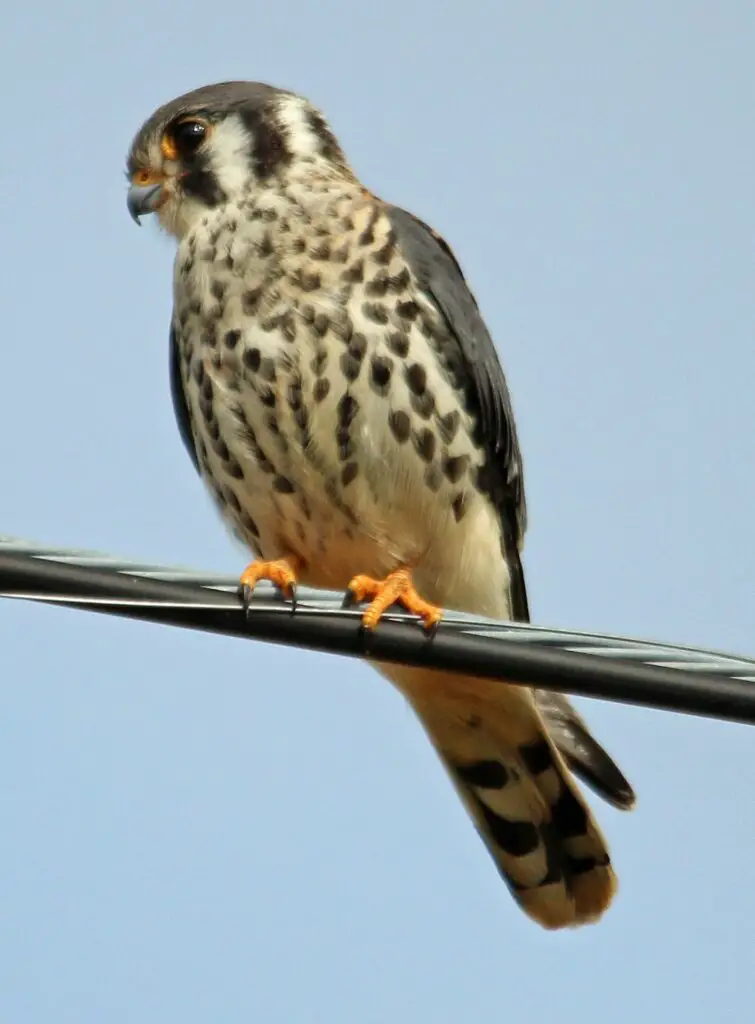
How good is a kestrels vision
Kestrels are a type of hawk known for their exceptional eyesight. Their large, forward-facing eyes provide them with excellent binocular vision, which they use to spot prey from a distance. Additionally, kestrels have perfect depth perception and can accurately judge the distance to their target. Their vision is so keen that they can even see individual blades of grass from high up in the air. In fact, kestrels rely so heavily on their idea that they have difficulty hunting at night. However, their sharp eyesight during the daytime allows them to quickly locate and capture small prey, such as rodents and birds. Overall, kestrels have some of the best vision of any raptor, making them highly efficient predators.
Is the Kestrel able to see just as well at night?
The Kestrel is a small but mighty bird of prey known for its incredible vision. In fact, the Kestrel’s eyes are so powerful that they can see ultraviolet light, which helps the bird to find food and navigate in low-light conditions. But what about at night? While the Kestrel’s night vision is not as sharp as its daytime vision, it is still quite good. Thanks to a special membrane in their eyes known as the tapetum lucidum, kestrels can reflect light back into their eyes, giving them an extra boost of light intensity and making it easier for them to see in the dark. As a result, kestrels are able to hunt a number of different prey successfully even after the sun goes down.
When the Kestrel is hunting or surviving in the wild, how does it use its sight?
The Kestrel is a bird of prey with keen eyesight that it uses to help it survive in the wild. The Kestrel’s eyes are more significant in proportion to its body size than those of other birds, and they are also positioned so that the Kestrel has a wide field of view. This allows the Kestrel to recognize potential prey from a distance and to keep an eye out for predators. The Kestrel’s eyes are also sensitive to ultraviolet light, which means that the bird can see colours that are invisible to human eyes. This is useful for tracking down camouflaged prey and for tracking urine trails left by rodents. In short, the Kestrel’s exceptional eyesight is a critical adaptation that helps it to be successful in the wild or a bonus for the falconer using the raptor.

Are kestrels colour-blind?
This question cannot be definitively answered because there has not been any scientific research conducted on the matter. However, it is believed that kestrels are not colour-blind. On the contrary, these birds have been observed to have strong reactions to different colours. For example, kestrels will often hunt for lizards that are sunning themselves on rocks that are brightly coloured. This suggests that they can see these colours and use them to help identify their prey.
So, while we cannot say for sure whether or not kestrels are colour-blind, they are likely able to see a wide range of colours. This ability gives them an advantage when hunting, as they can quickly spot their prey from a distance.
How good is a kestrel’s sight compared to a human’s?
A kestrel is a small hawk that is known for its keen eyesight. The bird’s large eyes are positioned on the front of its head, giving it excellent binocular vision. This allows the Kestrel to accurately judge distances and track fast-moving prey. In addition, the bird’s eyes are equipped with specialized cells that allow it to see ultraviolet light. This enables the Kestrel to find the hidden game and communicate with other kestrels using ultraviolet signals. By comparison, human eyesight is relatively poor(up to 8 times worse). We have stereoscopic vision, which allows us to judge distances, but our colour vision is limited, and we cannot see ultraviolet light. As a result, we are not able to see as well as a kestrel, especially in low-light conditions. However, our eyes are better adapted for close-up work, such as reading and writing.
Does a kestrel’s vision deteriorate with age?
The Kestrel is a small but mighty bird of prey. It has excellent eyesight, which it uses to spot potential targets from great heights. In fact, a kestrel’s eyesight is up to eight times better than a human’s. However, like all animals, a kestrel’s vision deteriorates with age. Studies have shown that the average Kestrel’s eyesight declines by about 20% between the ages of five and ten. While this may seem like a significant decrease, it is actually quite normal for a kestrel. In addition, the Kestrel’s excellent vision allows it to compensate for its ageing eyesight. As a result, even older kestrels are still able to hunt effectively. The Kestrel is a genuinely fascinating bird, and its hunting abilities are a testament to its keen eyesight among falconers.
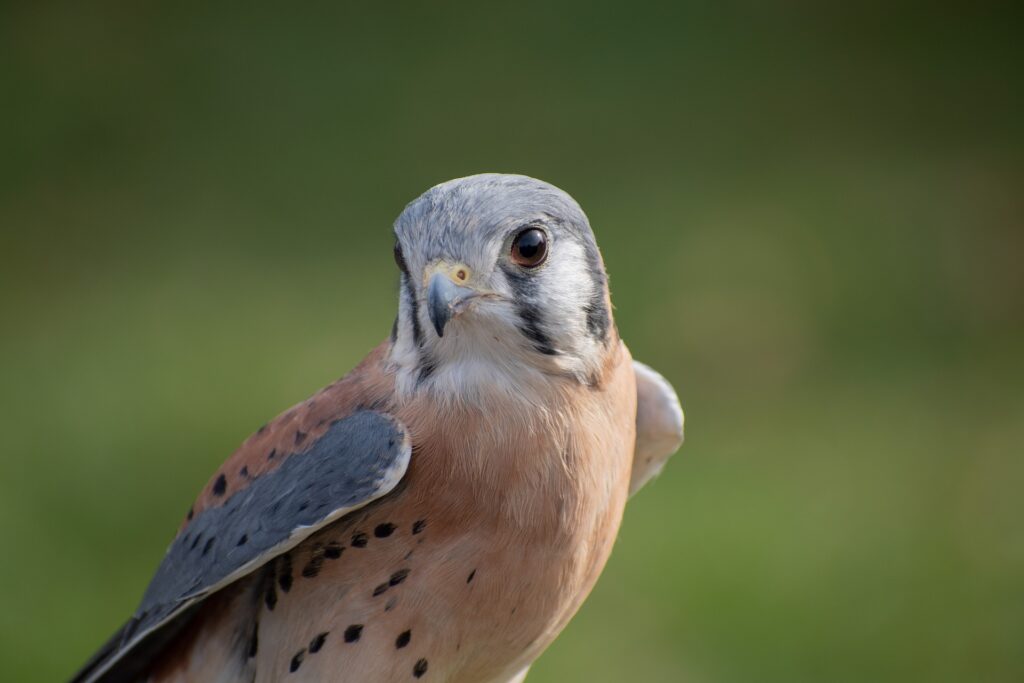
Have you ever seen a kestrel? If not, you may be in for a surprise because these little birds can see quite far. In fact, they possess some of the best eyesight of any animal. This means that they can spot their prey from a great distance and swoop down to catch it. Kestrels are just one example of how animals have adapted to their environment in order to survive.