

I can confirm their unmatched hunting skills by working closely with Harris Hawks in falconry. These hawks showcase a remarkable cooperative strategy, excelling in both team and individual hunts with intricate flight patterns. Their smart prey selection often targets rabbits, squirrels, and small birds. In my time in falconry, I have seen them hunt a wide range of prey, and I want to share that information with you so that in the content that follows, you will find what Harris Hawks hunt and how they do it both individually and when hunting in pairs.
How does Harris Hawks hunt?
Individual
A single Harris Hawk utilizes its agility and intelligence to hunt small prey, such as rabbits and birds, relying on surprise attacks and swift flights. In contrast, when hunting in pairs or groups, Harris Hawks employ a remarkable cooperative strategy, enhancing their ability to capture larger prey. They coordinate their flight patterns, surrounding and methodically closing in on their target, with each hawk playing a specific role. This teamwork not only increases their success rate but also protects the group, showcasing their exceptional hunting skills and strategic prowess.
Pairs or groups
When Harris Hawks hunt in pairs or groups, their cooperative approach is a spectacle of nature’s inherent strategy and intelligence. This collaborative method, rarely observed in birds of prey, involves a division of roles amongst the hawks, allowing them to effectively trap and hunt down prey larger than what a solitary hawk could handle. One hawk may take the lead in tracking and flushing out the prey while others wait in strategic positions, ready to strike.

This orchestrated ambush increases their hunting efficiency and minimizes the risks involved in capturing larger, potentially dangerous prey. The success of this method highlights the extraordinary social behavior of Harris Hawks, setting them apart from other raptors. Their ability to work together seamlessly, changing roles as needed and communicating through a complex series of calls and body movements, is emblematic of their advanced hunting tactics and social structure.
What do Harris Hawks hunt
Harris Hawks are versatile predators with a wide range of prey. Here are ten of the most common prey for Harris Hawks:
- Rabbits – A staple in the diet due to their abundance in various habitats.
- Ground Squirrels – An accessible prey, often hunted in open fields.
- Rodents – Including mice and rats, which provide a quick source of food.
- Birds – Small to medium-sized birds, including sparrows and pigeons, are often targeted.
- Lizards – Especially in desert environments, where they are a prevalent food source.
- Snakes – Including both venomous and non-venomous varieties, depending on the availability.
- Large Insects – Such as beetles and grasshoppers, are hunted, particularly by younger hawks.
- Quail – These birds are hunted for their size and nutritional value.
- Jackrabbits – Larger than cottontails, presenting a challenge but offering more sustenance.
- Ducks – Occasionally hunted near water bodies, showcasing the Harris Hawks’ adaptability.
These prey species highlight the Harris Hawks’ hunting prowess and their ability to adapt to various environments to sustain their diet.
How much weight can a Harris Hawk carry?
The carrying capacity of a Harris Hawk is a subject of much interest among falconers and bird enthusiasts. These robust raptors can carry an impressive amount of weight, generally around half, up to 1/3 of their body weight. On average, a Harris Hawk weighs between 700 to 1200 grams. Thus, they are capable of lifting prey around 350 to 600 grams and still maintain good flight.
This capacity allows them to transport various prey species, ranging from small rodents to larger birds. Their strong talons and muscular build enable them to grasp and lift off with their catch effortlessly. The table below outlines the approximate weights of different prey that Harris Hawks can carry, showcasing their remarkable strength and hunting proficiency:
| Prey | Average Weight |
| Rodents | 20-100g |
| Small Birds | 10-150g |
| Rabbits | 400-2000g |
| Ground Squirrels | 100-200g |
| Lizards | 5-150g |
| Snakes | 50-1500g |
| Large Insects | 2-10g |
| Quail | 150-300g |
| Jackrabbits | 1000-3000g |
| Ducks | 700-1500g |
This table reflects the versatility of Harris Hawks in hunting various prey; their ability to carry significant weight showcases their adaptability in different environments, ensuring their survival and positioning them as formidable hunters in the bird of prey community.
Harris Hawk hunting squirrels and other mammals
Hunting with Falconers
Harris Hawks, in partnership with their falconers, manifest a unique blend of traditional falconry and modern raptor management, especially when hunting squirrels and other mammals. The falconer releases the hawk in areas known for squirrel or mammal presence, often in wooded or open field environments. The hawk uses its keen vision to spot potential prey from high vantage points provided by the falconer, such as perches or the falconer’s glove.
This teamwork is pivotal; the falconer maneuvers through the terrain, flushing out squirrels and directing the hawk’s attention toward them. Once prey is spotted, the Harris Hawk employs its swift flight and powerful talons to capture it. The falconer then recalls the hawk, often rewarding it with a food morsel, reinforcing the hunting partnership.
Collaborating with Ferrets and Dogs
The collaboration between Harris Hawks, ferrets, and dogs adds another layer to their hunting strategy. When hunting with ferrets, the process targets burrow-dwelling mammals like ground squirrels. The ferret is sent into the burrows to flush the prey out, where the awaiting Harris Hawk quickly intercepts and captures the fleeing animal. This method is highly effective in densely vegetated or rocky areas where the hawk’s visibility might be limited.
Hunting with dogs particularly breeds with strong prey drives like pointers or retrievers, involves the dog scaring squirrels or other mammals off their hiding spots. The Harris Hawk then follows through with an aerial attack. The dogs are trained to work alongside the hawks, maintaining a safe distance to avoid disrupting the hawk’s pursuit or becoming inadvertently harmed.
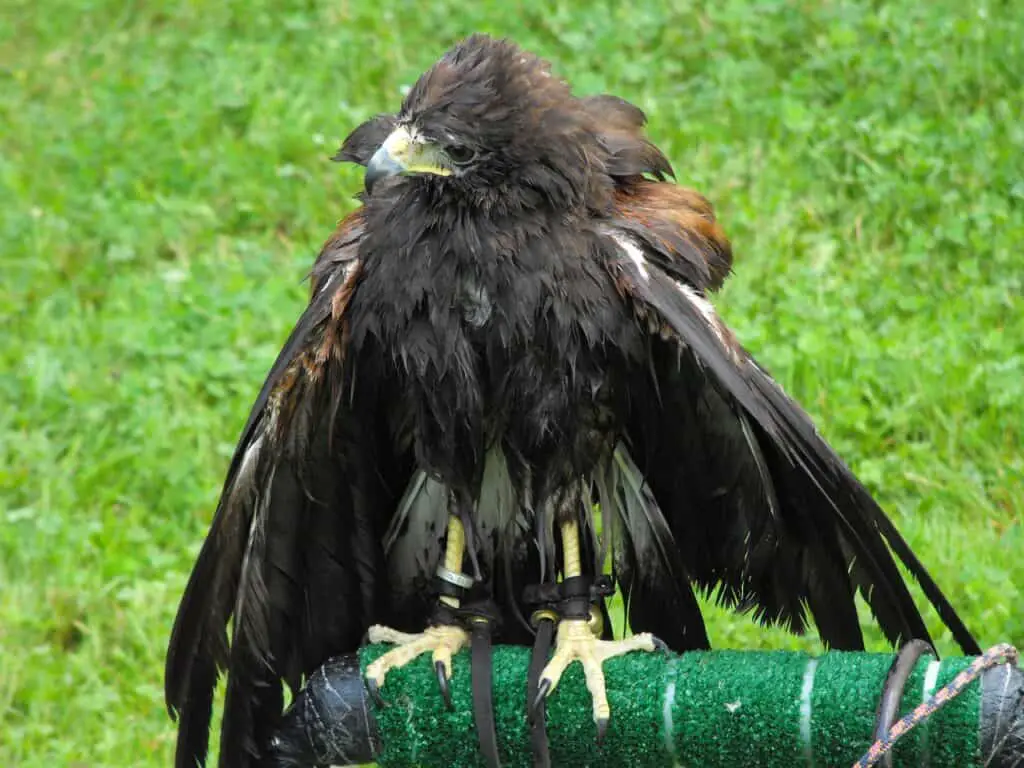
Both ferrets and dogs provide ground support, expanding the hunting territory accessible to the hawk and ensuring a higher rate of success. This synergy between ground and aerial hunters showcases the Harris Hawk’s adaptability and intelligence in utilizing resources and partners to optimize hunting efficiency. Whether with falconers, ferrets, or dogs, this collaborative hunting strategy underscores the Harris Hawk’s remarkable versatility and prowess as a hunter.
Can a Harris Hawk kill a fox?
With calculated precision and lethal prowess, a Harris Hawk is capable of taking down a fox when the need arises. Fox predation is a natural behavior for Harris Hawks, as they are skilled predators with sharp talons and beaks. In urban hunting scenarios, where foxes may pose a threat to wildlife or domestic animals, employing a Harris Hawk can be an effective wildlife management strategy. The predator-prey dynamics between a Harris Hawk and a fox are fascinating to observe, showcasing the bird of prey’s hunting instincts and agility.
When hunting a fox, a single Harris Hawk can successfully target and immobilize the fox with its sharp talons. The hawk’s speed and agility allow it to outmaneuver the fox, making it a formidable opponent in the wild. However, a pair of Harris Hawks working together can increase the chances of a successful hunt, demonstrating the effectiveness of teamwork in bird-of-prey hunting.
In conclusion, Harris Hawks are skilled hunters who use skill and power to catch their prey. They primarily hunt small mammals like squirrels and rabbits but can also take down larger prey like jackrabbits. While they may not typically go after foxes, they can be taught to do so; their sharp talons and keen hunting instincts make them formidable predators.