
Clear distinctions emerge when comparing my Cooper’s Hawk to a Sharp-Shinned Hawk. Cooper’s Hawks boast longer tails, while Sharp-Shinned Hawks sport smaller feet and legs. Both birds of prey are skilled hunters, possessing sharp talons and a fierce demeanor. Based on my time keeping these raptors, I will explain the differences between the two and cover which is better for a beginner and which is a preference among falconers.
The difference between Cooper’s Hawk and sharp-shinned
Several key differences stand out when comparing Cooper’s hawks and sharp-shinned hawks. From their diet preferences to their distinct sizes and shapes, these raptors showcase unique characteristics that set them apart. Understanding these variations can offer valuable insights into the behavior and ecology of these fascinating birds of prey.

Diet and hunting techniques
One of the primary differences between Cooper’s hawks and sharp-shinned hawks is their diet. Cooper’s hawks are considered “bird specialists,” meaning they primarily prey on other birds, such as pigeons, doves, and quail. On the other hand, sharp-shinned hawks are “generalist” hunters who will target a variety of prey, including small mammals like mice and chipmunks.
This difference in diet also influences their hunting techniques. As mentioned above, Cooper’s hawks typically carry their prey to a perch for feeding. In contrast, sharp-shinned hawks tend to consume their prey on the ground or in mid-air. This is because Cooper’s hawks rely on ambush tactics and need a secure perch to devour their catch, while sharp-shinned hawks hunt more actively and can eat on the move.
Lifespan and health
Cooper’s hawks and sharp-shinned hawks also differ in terms of their lifespan and overall health. Cooper’s hawks have a longer lifespan, with some individuals living up to 12 years in the wild and even longer in captivity. In comparison, sharp-shinned hawks have a shorter lifespan, with most living no more than five to seven years.
Furthermore, Cooper’s hawks are generally considered hardier and less prone to disease than sharp-shinned hawks. This may be due to their larger size and robust build, which allow them to better withstand harsh environmental conditions.
Size and shape
Size and shape are perhaps the most noticeable differences between these two hawks. Cooper’s hawks are larger and longer-tailed than sharp-shinned hawks, with a wingspan of up to 37 inches and a length of around 16-20 inches. On the other hand, sharp-shinned hawks have a smaller wingspan (around 24 inches) and are shorter in length (around 11-14 inches).
The size discrepancy also extends to their feet and legs. Cooper’s hawks have more massive feet and legs than sharp-shinned hawks with slender legs and small talons. This is because Cooper’s hawks are better equipped to take down larger prey, while sharp-shinned hawks rely on their agility and speed to capture smaller prey.
Tail Shape and Length
The shape and length of their tails are another distinguishing feature between Cooper’s hawks and sharp-shinned hawks. Cooper’s hawks have a more rounded tail with a squared-off end, while sharp-shinned hawks have a longer, more pointed tail.
This variation in tail shape is related to their hunting styles. The square-tipped tail of the Cooper’s Hawk provides better control during quick turns and helps them maneuver through dense vegetation when pursuing prey. In contrast, the sharp-shinned Hawk’s longer pointed tail assists with balance and stability during high-speed chases.
Flight Pattern
Finally, Cooper’s and sharp-shinned hawks also differ in flight patterns. Cooper’s hawks have a more powerful, sustained flight, while sharp-shinned hawks have a faster, darting flight.
This difference is due to the varying sizes of their wings and tail feathers. Cooper’s hawks have broader, rounded wings that allow for longer gliding periods, making them better suited for soaring at higher altitudes. Sharp-shinned hawks, with their narrower and pointed wings, are built for quick bursts of speed necessary for hunting smaller prey.
Head and Neck Features
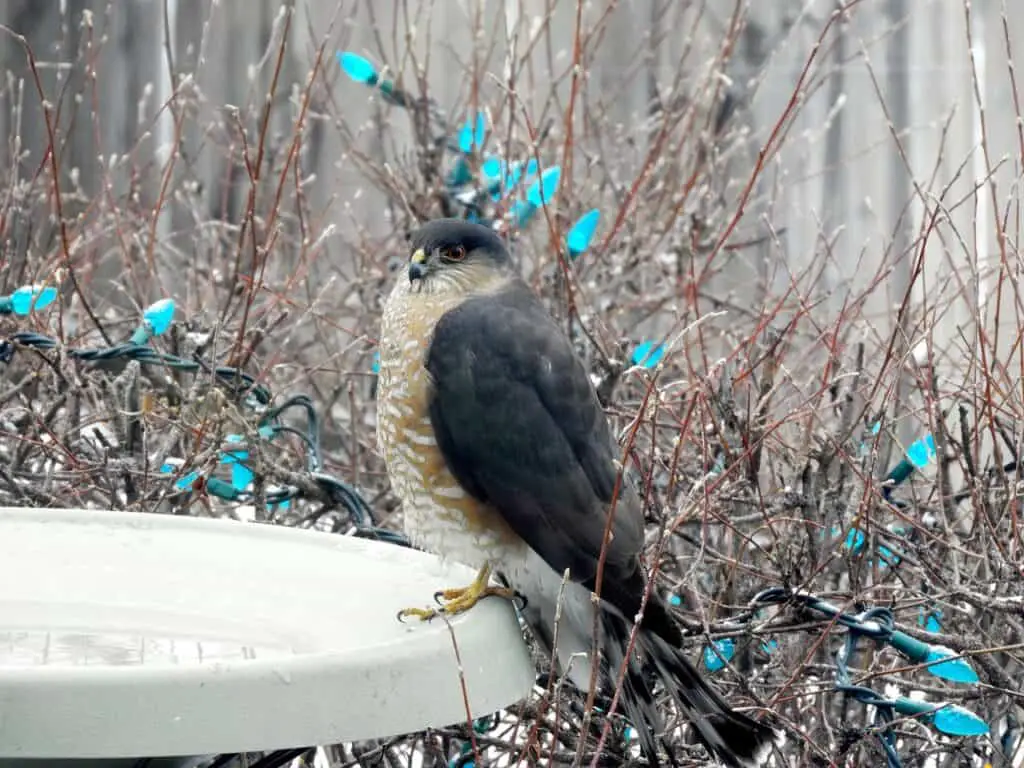
Cooper’s and sharp-shinned hawks can be differentiated by their distinct head and neck features, particularly in size and markings. When observing these birds up close, one can notice the intricate feather patterns around their eyes and neck. Cooper’s hawks typically have a darker cap on their head and a pale nape, while sharp-shinned hawks display a more uniform coloration throughout this region.
Additionally, their eye color varies, with Cooper’s hawks having bright red eyes compared to the yellow eyes of sharp-shinned hawks. Beak size is another key feature, as Cooper’s hawks possess larger, hooked beaks suited for capturing medium-sized prey, while sharp-shinned hawks have smaller, more delicate beaks for hunting smaller birds.
Posture differences also play a role in distinguishing these species. Cooper’s hawks exhibit a more robust and stocky build than sharp-shinned hawks’ slender appearance. Overall, these subtle differences in head and neck features contribute to each bird’s unique appearance and aid in their identification in the wild.
Legs and Feet
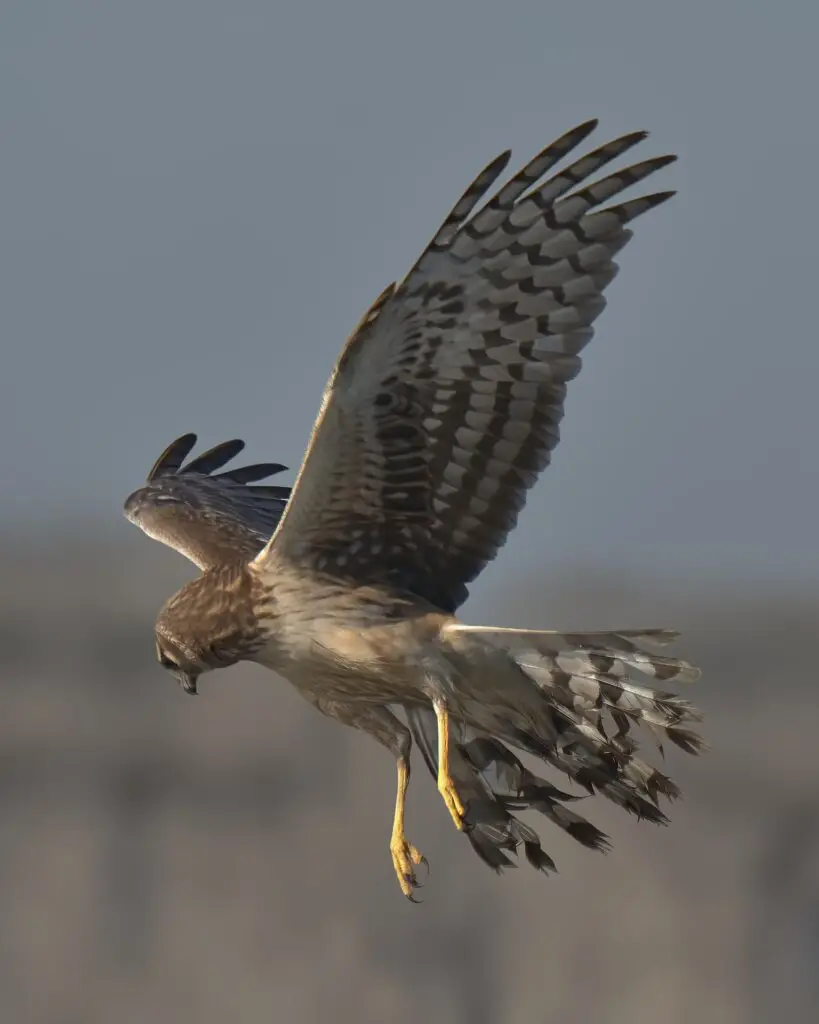
Notably, the legs and feet of these two hawk species exhibit distinct characteristics that aid in their differentiation. Cooper’s Hawks possess robust talons and strong gripping power, essential for their hunting strategy of ambushing prey from cover rather than pursuing them over long distances. Their larger talon size enables them to precisely catch medium-sized birds and mammals. On the other hand, Sharp-Shinned Hawks have slender legs and feet with sharp talons suited for capturing small, agile prey like songbirds. Their foot morphology allows for quick and agile movements, aiding their perching behavior and selecting selective prey.
Coloration and Markings
The Cooper’s Hawk and Sharp-Shinned Hawk can be distinguished with distinct coloration and markings. When comparing their feather patterns, the Cooper’s Hawk showcases a more prominent rusty-brown color on its back and wings, while the Sharp-Shinned Hawk tends to have a bluish-gray tint in these areas. In terms of size comparison, the Cooper’s Hawk is notably larger than the Sharp-Shinned Hawk, with a difference that becomes more evident when observed side by side.
Additionally, their wing coloration differs, with the Cooper’s Hawk displaying darker wingtips compared to the Sharp-Shinned Hawk’s more uniform wing color. Eye markings are another key distinguishing feature, as the Cooper’s Hawk typically exhibits a dark cap-like marking over its eyes, whereas the Sharp-Shinned Hawk shows a distinct white eyebrow-like line above its eyes. Lastly, the presence of belly bands sets them apart further; Cooper’s Hawks have thicker, more pronounced belly bands, while Sharp-Shinned Hawks have thinner, less conspicuous bands. These subtle yet significant variations in coloration and markings aid in correctly identifying these two raptors.
Hunting techniques
When considering the hunting techniques of these two hawk species, a distinct contrast emerges between the Cooper’s Hawk and the Sharp-Shinned Hawk. Cooper’s Hawks are known for their stealthy approach and quick strike capabilities. They often perch high, scanning the surroundings before swiftly swooping down on their prey with precise attacks. In contrast, sharp-skinned hawks use camouflage feathers and sharp talons to ambush their targets. They exhibit agile movements, swiftly navigating through dense vegetation to surprise unsuspecting prey.
Cooper’s Hawks display a more patient waiting strategy, observing from high vantage points before launching calculated attacks. Their hunting style involves meticulous planning and execution, ensuring a successful hunt. On the other hand, Sharp-Shinned Hawks rely on their speed and agility, darting through the air with swift movements to catch their prey off guard. Both species showcase remarkable hunting prowess, each employing unique tactics tailored to their specific strengths and environments.
Do falconers prefer Cooper’s Hawk or sharp-shinned Hawk?
Falconers generally tend to prefer the Cooper’s Hawk over the sharp-shinned Hawk for its larger size and versatility in hunting a wider range of prey. The Cooper’s Hawk’s bigger build allows it to take down larger game than the sharp-shinned Hawk, making it a preferred choice for falconers looking to hunt medium-sized birds such as pheasants or ducks. Additionally, its adaptability in various hunting environments, from wooded areas to open fields, provides falconers with more flexibility during hunting sessions.

Training differences between the two species also play a role in falconer preferences. While both hawks require similar training techniques, Cooper’s Hawk’s larger size can make it slightly easier to handle during training sessions. Behavioral similarities between the two species, such as their high energy levels and impressive agility in flight, make them both exciting choices for falconers. However, the challenges of falconry, like building a strong bond with the bird and ensuring its health and well-being, can be slightly easier with the Cooper’s Hawk due to its size and hunting style.
Are Cooper’s Hawk or sharp-shinned Hawk better for beginners?
For beginners in falconry, considering whether to start with a Cooper’s Hawk or a sharp-shinned Hawk requires careful evaluation of key factors. Both hawks have their pros and cons, so choosing the right one depends on various aspects such as training methods, equipment needed, housing requirements, socialization needs, and prey preferences.
Training methods for Cooper’s Hawks and sharp-shinned Hawks are quite similar, involving patience, consistency, and positive reinforcement. However, Cooper’s Hawks are slightly larger and may require more experience during training sessions. In terms of equipment needed, both hawks require jesses, anklets, and a suitable glove for handling.
Housing requirements for Cooper’s Hawks and sharp-shinned Hawks are relatively similar, with spacious mews or aviaries being essential for their well-being. Socialization needs vary between the two species, with Cooper’s Hawks generally being more tolerant of human presence compared to sharp-shinned Hawks. Understanding their prey preferences is crucial, as Cooper’s Hawks tend to go after larger prey like birds and small mammals, while sharp-shinned Hawks prefer smaller birds such as sparrows and finches. Ultimately, for beginners, starting with a Cooper’s Hawk might be slightly easier due to their size and temperament, but both species can be rewarding companions in falconry.
In my experience as a falconer, I have found that both the Cooper’s Hawk and the sharp-shinned Hawk have unique qualities and challenges. While the Cooper’s Hawk may be more powerful and impressive in size, the sharp-shinned Hawk is known for its agility and speed. Ultimately, the best choice depends on the individual’s skill level and preferences.