

Have you ever seen a Peregrine falcon in the wild? These birds are amazing to watch! They can fly incredibly fast, and they have excellent eyesight. They are often seen flying high and divebombing prey from great heights, but for them to be so elevated, how good are their visions?
A peregrine falcon is estimated to spot their prey from around 2 miles away (3.2km). Their vision supersedes a human’s vision by at least three times, meaning they can spot prey from a great distance away. Their vision is one of their most significant assets when it comes to the world of hunting.
A peregrine falcon’s eyesight has been marvelled at for centuries as these raptors can see things that they would never be able to spot, so this blog post will discuss just how far a Peregrine falcon can see. We will also talk about some of these birds’ other unique abilities. To gain a deeper understanding of these fascinating creatures, keep reading!
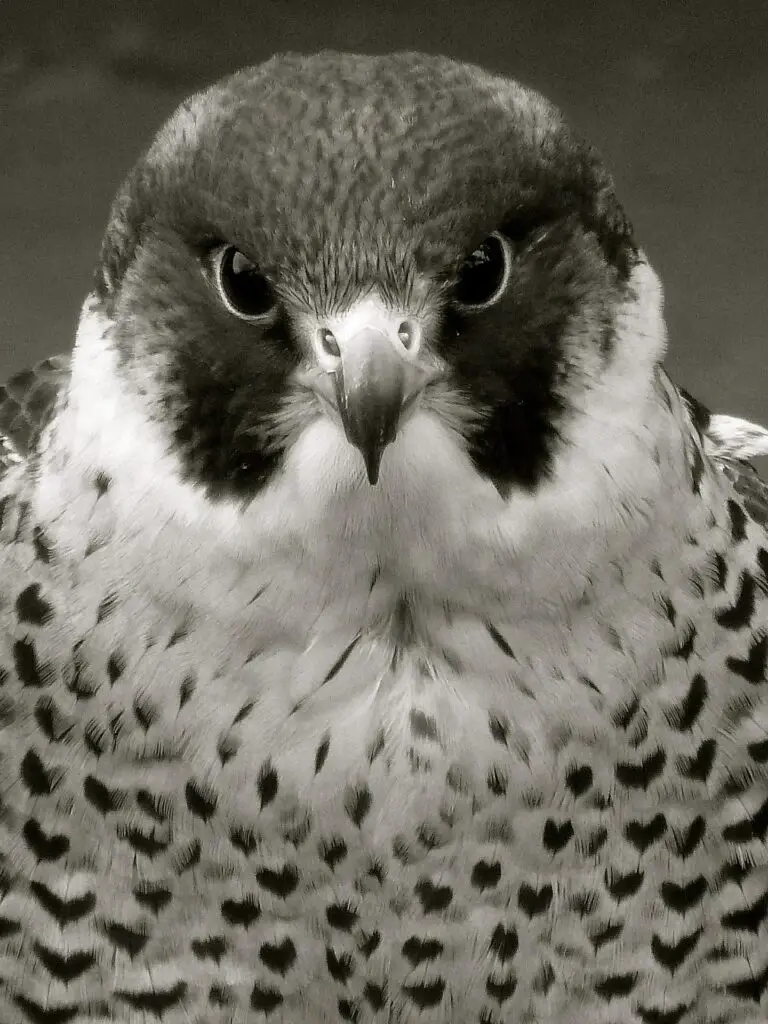
How good is a peregrines vision
In the world, the Peregrine Falcon is one of the most common birds of prey and is known for its exceptional hunting abilities. A large part of the Peregrine’s success as a predator is due to its keen eyesight. Peregrines have binocular vision, meaning that they can look clearly at the same time with both eyes. This gives them depth perception and allows them to judge distances accurately. Peregrines also have excellent eyesight in low-light conditions. Their eyes are significant in relation to their body size, and they have a high density of photoreceptor cells, which helps them to see well even in dim light. In addition, the Peregrine’s eyes are specially adapted to track fast-moving objects. As a result, the bird can turn its head quickly from side to side, following the movements of its prey with ease. Combined, these factors make Peregrine’s vision one of the sharpest in the animal kingdom.
Is the peregrine falcon able to see just as well at night?
There is a bit of complexity to the answer to this question. Peregrine falcons are diurnal creatures, meaning they are active in the day and sleep at night. However, they have been known to hunt at night on occasion. So, while they are not nocturnal, they do have some ability to see in low-light conditions. Their eyes are specially adapted to help them see in these conditions. For example, they have large pupils that allow more light to enter their eyes. They also have a layer of reflective tissue at the back of their eyes, which helps to amplify any available light. This allows them to see well enough to hunt at night, although they can be better during the day.
How does the Peregrine falcon use its sight for hunting and surviving in the wild
The Peregrine falcon is a predatory bird that uses its keen eyesight to hunt and survive in the wild. The falcon has excellent vision, which allows it to spot prey from a distance. When hunting, the falcon will perch on a high vantage point and scan the ground for movement. When it sees an animal, it will swoop down and capture it with its talons. The falcon’s vision also helps it to avoid predators. For example, the falcon can see other birds of prey, such as eagles and hawks, from a distance and will take evasive action to avoid being attacked. In addition, the falcon’s eyesight enables it to navigate through dense forests and rocky terrain. By day or night, the Peregrine falcon uses its exceptional vision to stay safe and catch prey.
Are peregrine falcons colour blind?
The peregrine falcon is an amazing bird of prey because of its incredible speed and agility. While the peregrine falcon is not technically colour-blind, its ability to see colours is somewhat limited. Peregrine falcons have a poor colour vision in low light conditions and cannot see any colours. However, peregrine falcons make up for their poor colour vision with excellent night vision and an uncanny ability to track fast-moving objects. In fact, peregrine falcons are so adept at hunting that they are sometimes used in falconry demonstrations. Though they may have somewhat limited eyesight, there is no doubt that peregrine falcons are skilled predators thus they are adored by falconers.
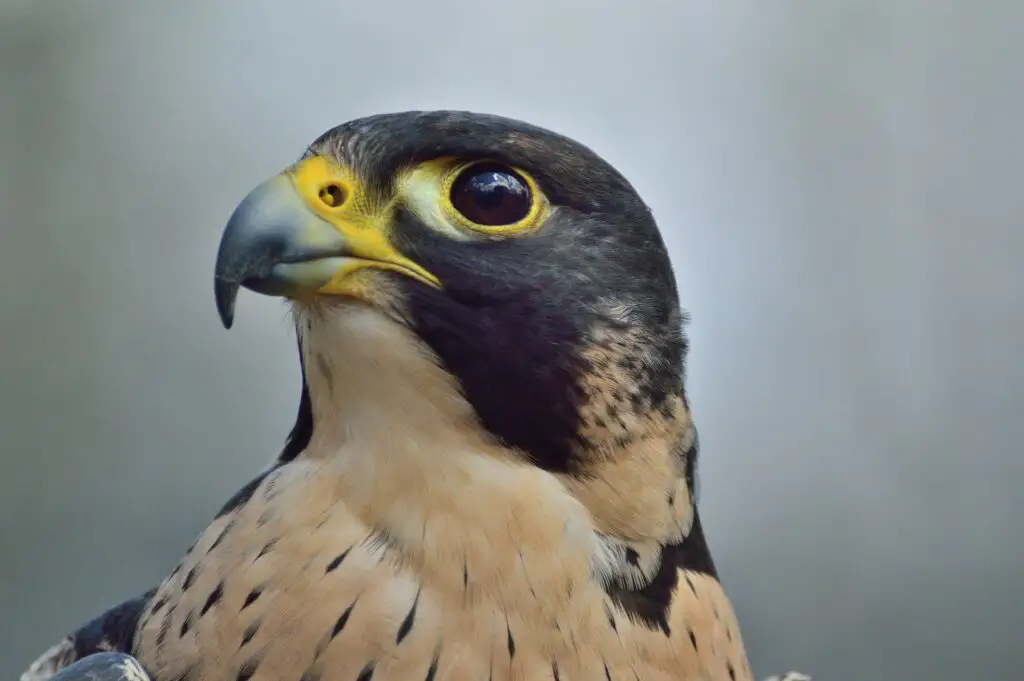
How good is a peregrine falcon’s sight compared to a human’s?
While the average person has 20/20 vision, peregrine falcons are able to see up to eight times better. Falcons rely on their excellent eye for hunting, as they often spot their prey from great heights. Their keen eyesight is due to a number of adaptations, including large pupils and front-facing eyes. Peregrine falcons also have many light-sensitive cells in their retinas, allowing them to see even in low-light conditions. In addition, their eyes are tilted forward in their sockets, giving them binocular vision and allowing them to judge distances accurately. Thanks to these adaptations, peregrine falcons are able to spot small animals from far away and dive at speeds of over 240 miles per hour to catch them this is why they are so popular in falconry.
Does a peregrine’s vision deteriorate with age?
Peregrines are known for their excellent eyesight, which allows them to spot prey from great heights. However, it needs to be made clear whether their vision deteriorates with age. Some studies have shown that older peregrines have difficulty distinguishing between colours, while other studies have found that their eyesight remains sharp throughout their lifespan. Different individuals may experience different levels of vision loss as they age. However, more research is needed to confirm this. In any case, it is clear that peregrines rely heavily on their eyesight for hunting and survival. Therefore, any deterioration in their vision could significantly impact their ability to survive in the wild.
If you want to see a Peregrine falcon in action, there’s no need to travel far. These birds of prey falconers aviaries and falconry centres and are known for their incredible speed and agility in the air. What’s even more impressive is that they can spot their prey from great distances. So if you’re lucky enough to witness one hunting, know that it was probably eyeing its target from high.