
Understanding the proper aviary dimensions for falconry birds is critical for their health, welfare, and performance as hunting partners. Birds of prey require specialized housing that accommodates their unique physical characteristics and behavioral needs.
This article details recommended aviary sizes for various falconry species, taking into account factors such as wingspan, hunting style, and stress management.
General Principles for Aviary Sizing
Wingspan as a Determining Factor
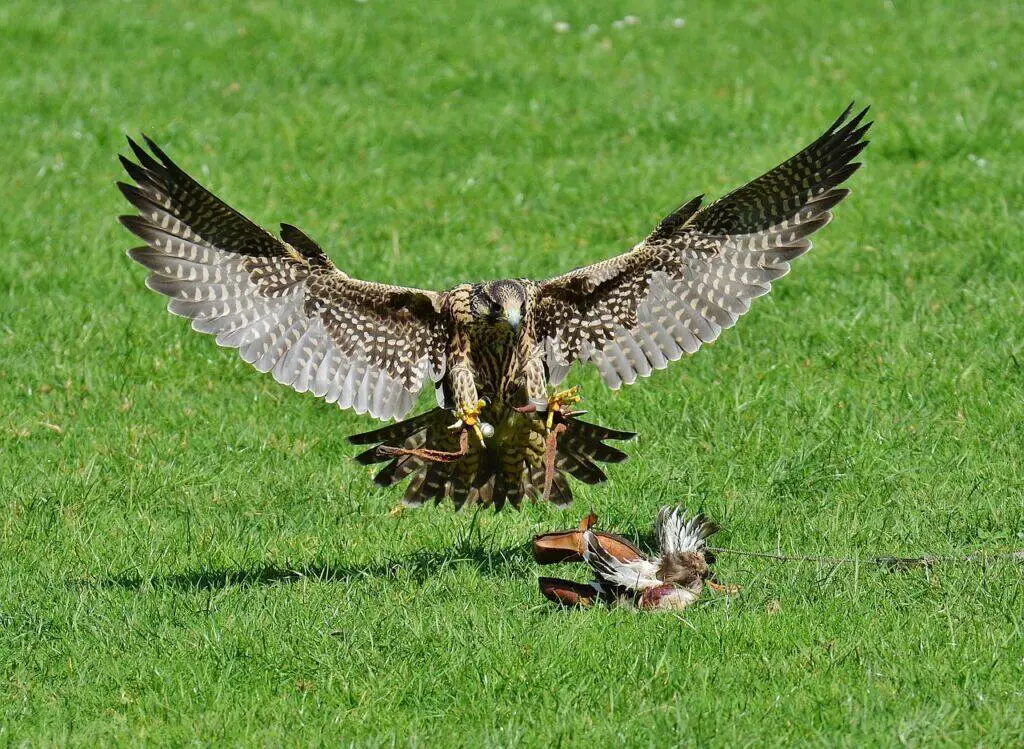
The wingspan of a raptor serves as a fundamental guideline when designing appropriate housing. Multiple sources recommend that aviaries should provide sufficient space for birds to fully extend their wings and flap them vigorously for exercise. As a general rule, the length of an aviary should be at least 7 times the bird’s wingspan, with the width being at least half that length. This will ensure you provide them with the perfect environment to thrive.
Height vs. Width Considerations
For birds of prey, height is particularly crucial as it provides a sense of security. Research with various raptors has shown that aviary height significantly influences breeding success and stress levels. When birds perch at elevation, they perceive potential threats as being more distant due to the angle of vision, which reduces stress. However, extremely tall aviaries (over 250 cm or 98 inches) can make bird capture challenging when necessary.
Recommended Aviary Sizes by Species
Small Falcons (Kestrels and Merlins)
Kestrels (Falco tinnunculus) and Merlins (Falco columbarius) are among the smallest falcons used in falconry, with wingspans ranging from 191-272 cm (75-107 inches).
For single Kestrels:
- Minimum size: 200 × 120 × 180 cm (79 × 47 × 71 inches)
- Optimal size: 500 × 200 × 250 cm (197 × 79 × 98 inches)
Up to five juvenile kestrels can be housed together in aviaries of the larger size. The aviary should have three solid sides, and the fourth should be constructed of appropriate mesh to prevent feather damage.
Medium Falcons (Peregrines and Hobbies)
Peregrine falcons (Falco peregrinus) with wingspans of 291-367 cm (115-144 inches) and Hobbies (Falco subbuteo) with wingspans of 300-347 cm (118-137 inches) require more substantial space.
Recommended dimensions for a single adult Peregrine:
- Length: 350 cm (138 inches)
- Width: 600 cm (236 inches)
- Height: 250 cm (98 inches)
Adult Peregrines should be housed individually in larger aviaries due to their territorial nature. Their powerful flight capabilities and hunting style necessitate additional space compared to smaller falcons.

Hawks (Buteos)
Red-tailed Hawks (Buteo jamaicensis), Harris’s Hawks (Parabuteo unicinctus), and other buteos require proportionally wider aviaries due to their broader wingspans.
For a single hawk:
- Length: 350 cm (138 inches)
- Width: 250 cm (98 inches)
- Height: 250 cm (98 inches)
For small hawks, a minimum area of 107 sq. ft. (10 sq. m) per bird is recommended1. According to the International Association of Falconry, very tame and calm individuals, especially Buzzards and Harris Hawks, may be kept in aviaries made completely from mesh wire, which is less common for other species.
Accipiters (Goshawks and Sparrowhawks)
Accipiters like the Northern Goshawk (Accipiter gentilis) and Sparrowhawk (Accipiter nisus) are forest-adapted hunters with distinctive flight patterns requiring aviaries that accommodate their quick, agile movements.
Minimum recommendations:
- Length: 400 cm (157 inches)
- Width: 300 cm (118 inches)
- Height: 250 cm (98 inches)
These “true hawks” have shorter, rounded wings and longer tails compared to buteos, which influences their housing requirements.
Eagles and Large Birds of Prey
Eagles and other large raptors require significantly more space due to their impressive wingspans and powerful flight capabilities.
For large birds such as Golden Eagles (Aquila chrysaetos) and large vultures:
- Minimum area: 215 sq. ft. (20 sq. m) per bird
While specific dimensions may vary, aviaries for these large birds should provide ample space in all directions to accommodate their size and flight needs. The substantial size of these birds necessitates robust construction techniques and specialized perching options to support their weight and prevent health issues.

Specialized Aviary Considerations
Breeding Aviaries
Breeding pairs require additional security and space. For most falcons, breeding aviaries should be:
- Length: 600-1200 cm (236-472 inches)
- Width: 400-600 cm (157-236 inches)
- Height: 400-500 cm (157-197 inches)
Providing adequate height for different species reduces stress during breeding season. Experience with Birds of prey has shown a strong relationship between breeding success and the sense of security experienced by pairs in their aviaries.
Molting Aviaries
During the molting period, birds need sufficient space to prevent damage to new feathers. Aviaries similar in size to breeding aviaries are recommended, with particular attention to perch placement and materials. This is especially important as falconry birds typically spend the non-hunting season in these facilities.
Training and Conditioning Aviaries
For birds undergoing training or conditioning, progressive housing may be beneficial:
- Initial training: Medium-sized spaces with controlled flight opportunities
- Conditioning: Larger aviaries allow more extensive flight capability
Construction and Safety Features
Enclosure Materials
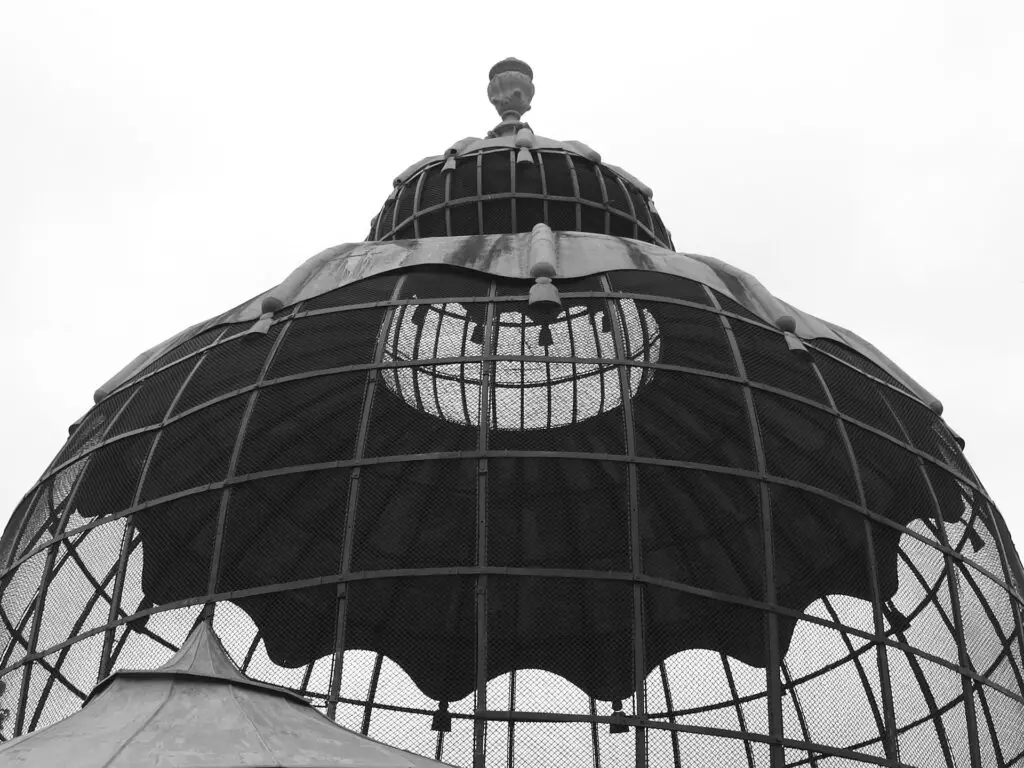
For most falconry birds, enclosed aviaries with non-transparent materials on three sides are generally preferred over full-mesh designs. According to the International Association for Falconry, while some very tame birds can be kept in all-mesh aviaries, most raptors need wire mesh that is shielded or covered to prevent damage to feathers, beaks, and primary flight feathers.
Security Considerations
Aviary security is paramount to protect birds from predators and prevent escape. Mesh specifications should be appropriate to the species housed, with proper attention to the following:
- Maximum square hole size: 50 × 50 mm (2 × 2 inches)
- Maximum rectangular hole size: 25 × 75 mm (1 × 3 inches)
- Wire thickness: at least 1.6 mm (0.06 inches)
A safety door or corridor must be provided to prevent escapes. Additionally, three sides should be closed-boarded with appropriate protection on mesh surfaces to prevent feather damage.
Conclusion
Providing appropriate aviary space for falconry birds is essential for their physical health, psychological well-being, and performance as hunting partners. While minimum sizes provide a baseline, falconers should strive to offer their birds the largest practical aviary space, particularly during non-hunting periods like molting. By understanding the specific requirements of different raptor species and implementing appropriate housing designs, falconers can ensure their birds remain in optimal condition year-round while respecting their natural behaviors and welfare needs.
Ready to expand your knowledge further? Check Out Our Related Articles below:
Best Materials for Falconry Mews: Building Durable and Safe Raptor Housing
Ensuring Safety: A Falconers Guide to Predator-Proofing Your Aviary