The relationship between falconer and raptor forms the foundation of successful falconry. Before any hunting training begins, a critical process must take place, and that is socialization. In traditional falconry, this process is called “manning,” but it encompasses much more than simply taming a wild bird.
It’s about building a partnership with a creature that isn’t naturally inclined toward human companionship. Having worked with numerous birds over the years, I’ve found that proper socialization can distinguish between a bird that merely tolerates handling and one that thrives in the falconry partnership.

Understanding Raptor Psychology
Raptors aren’t social creatures by nature. Unlike dogs or horses that have evolved alongside humans, birds of prey are solitary hunters with instincts honed for survival in the wild. When working with these magnificent birds, it’s essential to understand their perspective, which differs fundamentally from our own.
For a newly acquired raptor, human presence represents a potential predator. Their first instinct is to escape or defend themselves. The socialization process aims to replace that fear response with comfort and, eventually, trust. This transformation doesn’t happen overnight, and rushing it creates lasting problems in the bird’s training journey.
The Bird’s Perspective
Understanding how raptors perceive their environment helps create effective socialization strategies. Birds of prey are:
- Naturally wary of new situations and stimuli
- Highly sensitive to movement and direct eye contact
- More comfortable at higher elevations
- Primarily motivated by food and survival instincts
- Individual in their temperaments and responses
Traditional Manning Approaches
Traditional falconry has employed various methods to acclimate birds to human presence for centuries.
The Waking Method
One traditional approach involves “waking,” where the newly trapped bird is kept awake for an extended period while being exposed to normal household activities. The theory behind this method is that:
- The bird experiences a state of shock after being trapped
- During this period, flooding the bird’s senses with its new environment accelerates acclimation
- Sleep deprivation combined with an empty crop helps bring the bird to its “flying weight.”
While many traditionally trained birds become steady around unusual objects through this method, it can sometimes result in deep-seated fears of specific stimuli.
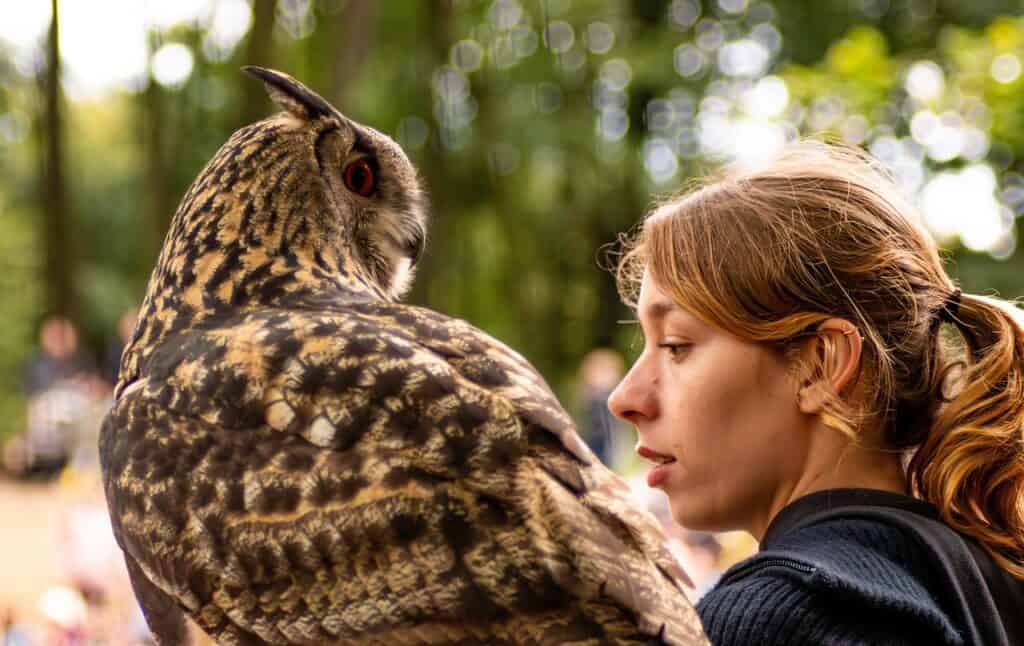
Food Association
Traditional manning heavily relies on food associations. By controlling the bird’s food intake and being the exclusive source of food, the falconer establishes itself as a valuable resource. Over time, the bird learns that human presence signals food rather than danger.
Modern Approaches to Socialization
Many contemporary falconers have moved toward less intensive socialization methods that prioritize reducing stress and building positive associations.
The Green Zone Approach
This approach focuses on expanding what trainers call the “green zone” – the state where the bird feels comfortable and unstressed. Rather than pushing birds into high-stress situations (the “red zone”), we work within the bird’s comfort level, gradually expanding it through positive reinforcement.
Concealed Approach Method
Some modern techniques involve a more gradual introduction to human presence:
- Allowing the bird to eat in controlled lighting where the human form is obscured
- Gradually revealing the human presence as the bird grows comfortable
- Using dark-to-light methods where lighting is adjusted during early interactions
Practical Socialization Techniques
When beginning the socialization process with a new bird, several practical techniques have proven effective in my experience:
Body Positioning
How you position yourself and the bird can significantly impact trust-building:
- Hold the bird higher than eye level to improve its comfort level
- Lower your eyes and avoid direct stares, which predators use before attacking
- Use peripheral vision rather than direct eye contact in early sessions
These subtle adjustments significantly affect how quickly a bird accepts human presence.

Environment Control
The bird’s environment plays a crucial role in successful socialization:
- Initially, provide a quiet, low-stimulation environment
- Gradually introduce new experiences one at a time
- Ensure proper housing with appropriate perches and no tempting higher spots
- Control ambient activity until the bird shows comfort
Beyond Hunting Activities
One of the most effective modern socialization techniques involves spending time with your bird outside of hunting contexts:
- Take your bird on non-hunting outings
- Allow the bird to be present during everyday activities
- Create positive associations beyond just the hunting field
Comparing Socialization Approaches
| Approach | Core Principle | Benefits | Potential Challenges |
|---|---|---|---|
| Traditional Manning | Intensive exposure through waking | Fast acclimation to multiple stimuli | Potential for creating deep-seated fears |
| Food Association | The clear motivation for cooperation | This may lead to a food-fixated relationship | This may lead to a food-fixated relationship |
| Green Zone Method | The bird learns humans provide food | Lower stress builds genuine trust | It may take longer initially |
| Gradual Exposure | Slow introduction to stimuli | Bird develops confidence naturally | Requires more patience and time |
Signs of Successful Socialization
How do you know when your socialization efforts are working? Look for these positive indicators:
- The bird maintains a relaxed body posture in your presence
- Feathers remain sleek rather than puffed (except when relaxing)
- Normal preening behavior occurs while you’re present
- The bird willingly steps onto the glove without hesitation
- Eating comfortably in your presence without mantling (protective wing posture over food)
- Voluntary return to the glove even when not extremely hungry
Common Challenges in Socialization
Even with the best approaches, challenges can arise:
Individual Temperament
Just as with people, birds have individual personalities. Some naturally acclimate more quickly, while others require additional patience. A technique that works perfectly with one bird might need adjustment for another.
Special Cases
Some birds present unique socialization challenges:
- Retired breeding birds
- Birds that weren’t flown in their first few years
- Birds that experienced improper handling previously
These birds often have established psychological patterns that require specialized approaches.
Understanding Difficult Birds
When working with particularly challenging birds, remember that what might look like stubbornness is usually confusion or fear. The falconer’s job is to create understanding between two very different species, which requires patience and creativity.

Conclusion
The socialization process is the foundation of all falconry training. Understanding raptor psychology and approaching socialization with patience and respect can build the trust needed for a successful partnership.
Socialization isn’t just a first step—it’s a step-by-step process throughout your relationship with your bird. The time spent on thoughtful socialization enhances every aspect of training and hunting.
In my years of falconry, I’ve found that the birds themselves are our best teachers. Each raptor brings unique challenges and rewards, and learning their language and earning their trust is one of the most fulfilling parts of this ancient art.
Lure training is just one essential skill in falconry. Ready to expand your knowledge? Explore our expert guides on handling, conditioning, and hunting strategies to take your falconry skills to the next level!
Explore our related topics below:
Manning in Falconry: The Key to Building Trust and Training Success